
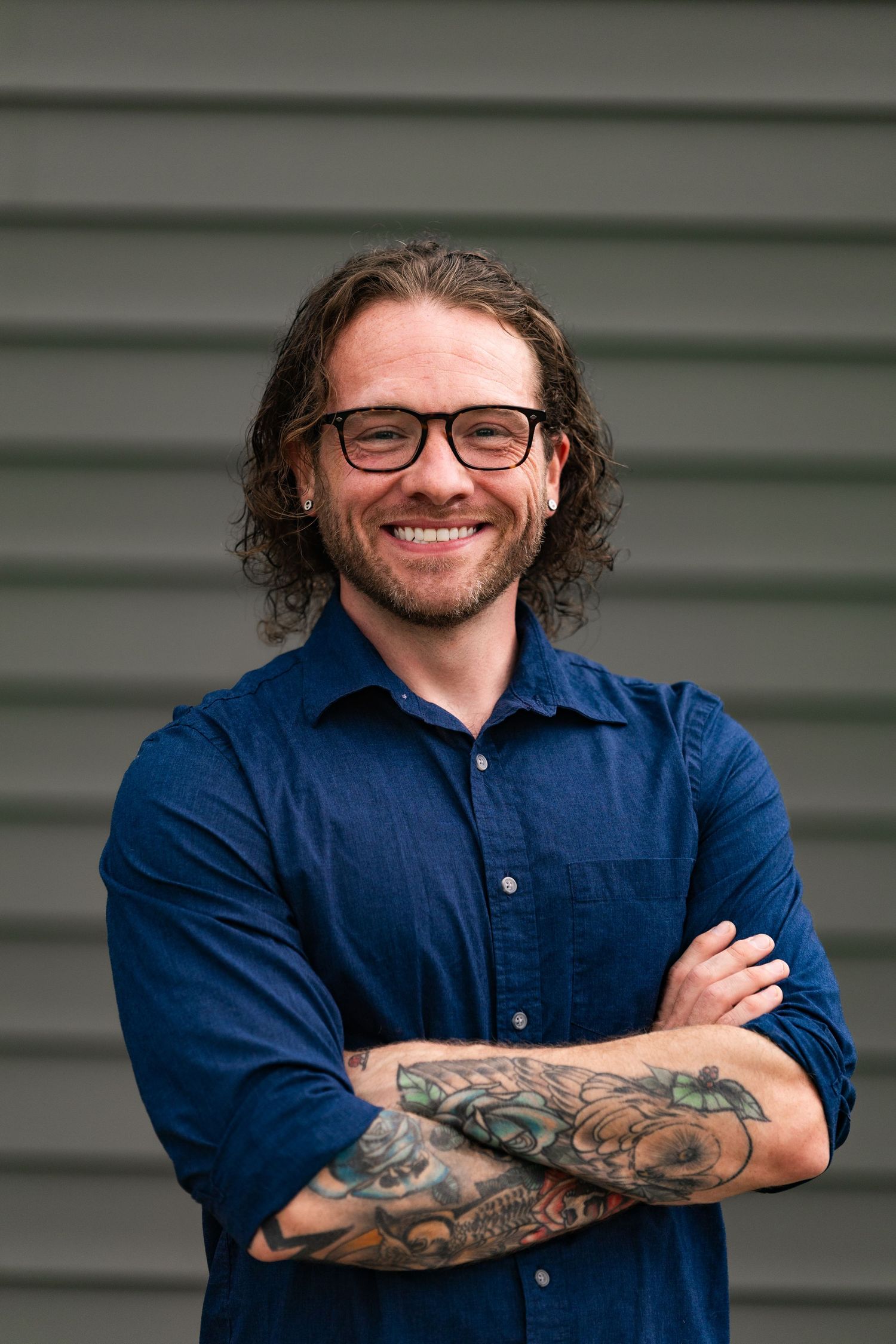
In early September I was honored to be a guest speaker at the 2025 OhioHealth Forensic Nurse Symposium, focusing on empowering male survivors of domestic violence and sexual abuse. My story centered around my chaotic childhood and how it shaped my adulthood, my fall into addiction and how I eventually found power in being vulnerable and breaking the silence I’ve kept for so long.
This was my first public speaking event and let me tell you, it was emotional. Unfortunately I did not time myself the best and had to cut some of my story short. With that said, I wanted to finish what I started and share more about the power of safe havens, my fall and ultimately my recovery.
What I’ve come to understand is that healing doesn’t start with pretending everything is okay. Healing begins when we own our story and begin to tell our stories.
As I mentioned while speaking, and I want to be clear here as well, I’m not here as a therapist or as a mental health expert. I’m simply someone who lived it; a kid who survived domestic violence, sexual abuse, and silence, a man who fell into addiction and self-destruction. Despite all of this, I found a way back.
For those who may be new and did not hear/view my story, I want to briefly share some details from my childhood.
You see, for most of my life, silence was survival. I grew up in chaos full of violence, abuse, neglect, addiction, and learned to bury pain so deep it almost killed me. Like many men, I wore masks, and I got very good at it. Confidence, humor, charisma; I had a mask for it all. On the outside, I was gleaming. Inside, it was the upside down; dark, scary, breaking.
Childhood in Chaos
I didn’t grow up with safety. My mother battled addiction, my father was violent and an alcoholic. After my parents separated, my mother took me and my siblings, one older brother and sister, one younger sister, and remarried. Enter my stepfather and my younger brother was born shortly after. That’s right, five kids. My biological father disappeared a lot in my early childhood, so it was primarily us kids, my mother, and my stepfather.
The abuse and neglect grew so much that by time I was two, my siblings and I were in foster care where we resided for about a year.
When we were released back to our mother, life didn’t get better. In fact, you could argue it got worse. My stepfather brought years of violence, physical abuse, and sexual abuse into the house. My mother was lost in her own addiction and struggles. Not only was she just not able to protect us, she became a pivotal part of the harm.
Some of my memories are impossible to shake:
- My first memory was not of something joyful, but rather full of hands touching me in ways a child should never be touched.
- Being a small boy and witnessing my older sister being raped by my stepfather and my mother covering by telling my brother and I, “Everything is fine, this just happens sometimes”.
- Being put in multiple situations where my boundaries were violated, leaving me scared and confused.
- Witnessing both of my sister’s experience years of trauma caused by sexual abuse.
- Feeling fear of the consequences of speaking up on what I witnessed.
- Silence prevailed.
- Experiencing violence so intense that I was dragged out of a van by my ankles, beaten, and dropped face first onto gravel; distinctly remember tasting blood in my mouth.
- In my adolescent years, being touched and sexually assaulted by two youth pastors.
Long story short, that was my childhood. It was a mix of fear, silence, and shame. Where I was supposed to find safety, I found betrayal.
The worst part of it all though; the silence. When people see signs of abuse and choose to look away, the message a child hears is no one is coming to save you.
But that was my reality: parents who were supposed to protect my siblings and me, destroying us instead.
The Power of Safe Havens
But here’s the other side of my story…it wasn’t all darkness. There were families in my life who gave me an escape, who didn’t always know the details of what was happening in my house, but they knew enough to welcome me in.
Even in the darkness, there were glimmers of light.
I had friends, Mike, Joe, and Ben, whose homes became sanctuaries. I ate at their tables, laughed with their families, and for a little while, felt like a normal kid in a normal family. When my mother was lost in one of her binges, Joe’s family took me in for a week. They didn’t ask questions; they just gave me safety.
As I got older, there were other families; my buddy David and his family, and later, one of my best childhood and early adulthood best friends, Ricky. Ricky’s family eventually became my in-laws after I married his sister. This changed the trajectory of my life. They showed me what love and safety could look like.
You see, when you grow up in chaos, you don’t know what normal is. You need someone to show you.
If you’re reading this and your child has a friend who’s always at your house, pay attention. Your home might be their safe haven. Listening, believing, and showing compassion can mean everything.
Sometimes survival doesn’t look like a dramatic rescue. Sometimes survival looks like a warm meal, a safe couch, an open door. Sometimes survival looks like love, quietly offered, over and over, until it sinks in.
Adulthood & Alcoholism
As I stepped into adulthood, I realized trauma doesn’t just stay behind. It doesn’t disappear when you grow up. It mutates. It follows you. And for me, it followed me straight into my adult life.
I married young, thinking I finally had a shot at a normal family. On the outside, I was building a home, a marriage, a future. Inside, I was drowning. I didn’t know how to process my past. In my house growing up, feelings meant weakness. So, I did what I always did. I hid it. Smiled. Joked. Wore the mask. And the closer people got, the more I pushed them away. Deep down I believed what childhood had taught me: if my own parents couldn’t love me, how could anyone else?
The weight of that broke my first marriage. After the divorce in 2017, I spiraled into depression. My finances collapsed, my health declined, and I turned fully to alcohol. At first it was just drinking to take the edge off. Then it became my medicine, my escape. Soon, it was my master. From the moment I woke up to the moment I went to bed, I had a drink in my hand. I was a functioning alcoholic, disappearing in plain sight.
By December 2020, I was at my breaking point. My longest post-divorce relationship had ended, my mental health was wrecked, and alcohol had consumed my life. I was exhausted, tired of fighting, tired of barely holding it together. One night, I made the choice to give up, to end it all and I attempted to take my life. What's crazy is when I awoke in the hospital, I wasn't relieved, I was pissed. Angry I had to keep going. A week in a mental hospital gave me a pause, but even that didn’t stop me from drinking.
January 2021, it got darker still. One night, still drinking and a drink in hand, I looked into my son’s eyes and what I saw wrecked me. For the first time, I saw the same pure disappointment I once reserved for my parents. That moment broke me. I realized I was becoming everything I swore I’d never be. I wasn’t breaking the cycle; I was repeating it. That was the darkest moment of my life.
And that’s when I stopped. Not because I was strong or because I found the perfect program. But because I couldn’t stand the thought of being the reason my kid carried some of the same scars I do.
I threw out all the alcohol I had, and I’ve been sober ever since.
My point here is trauma doesn’t vanish when boys grow up. It doesn’t fade. It mutates. It becomes addiction. It becomes rage. It becomes silence that eats you alive.
And when men break, we usually do it in private.
We suffer quietly.
We drink, we implode, we self-destruct where no one can see.
Sometimes that silence kills us. And sometimes, if we’re lucky, something cracks it open, and we get a reason to fight back.
Sobriety, Resilience, and My Sister’s Passing
2021 was the year my life finally began to change. I put the bottle down. I threw myself into therapy. I started working on my physical, mental, and emotional health.
For the first time, I wasn’t numbing the pain, I was facing it. And facing it was harder than drinking ever was. When you put the bottle down, the memories come back. The guilt. The shame. It all comes flooding back. Recovery isn’t a straight line; it’s one step forward, two steps back. But I kept stepping.
I took that year to focus on myself and my son. And in the winter, I met Megan, now my wife. She didn’t meet me at my lowest. Instead, she met me when I was starting to rebuild and was feeling my best to that point. Even still, she saw right through me. She saw the pain I carried, but also the man I could be. With her, I finally felt safe enough to start breaking down the walls. I started chipping away at the chains. The more I opened up, the more she believed in me. For the first time, I began to believe I was worth more than my past.
That belief pushed me to speak out. First it was small things, posts about men’s mental health and sobriety. But it grew. I started using my voice for the thing I had run from my whole life: the truth.
I learned that recovery isn’t about erasing the past. It’s about owning it. Saying: yes, this happened. Yes, it hurt. And yes, I’m still here. I believe vulnerability is a revolution. Because the moment you stop hiding, the moment you tell your story, the chains start to break; and not just for you, but for the people listening.
Then, in March of 2022, life hit me again. My older sister, who carried even deeper scars than I did, passed away unexpectedly.
Her and I didn’t get along for years. I refused to look back. In fact, I had my own version of Stockholm syndrome. Despite everything my parents did to us, I grew close to my stepfather. I defended him. I even admired him. That’s the power of unprocessed trauma; it twists survival into loyalty. Only when I became a father myself did cracks begin to form. Memories started surfacing. Slowly, I began to distance myself from them. And eventually, my sister and I started to reconnect. By my mid-30s, we were closer than ever. Then, just like that, she was gone.
And just like when I was a kid, I couldn’t save her.
That’s a weight I will always carry. Her death cracked me wide open. Memories I had buried for decades came flooding back. They were dreamlike, nightmarish, but real. I started getting angry.
At her funeral, my mother barely showed emotion. My stepfather didn’t even show up. My anger boiled over. I blamed them for her death, for everything. For what they did, for what they allowed, for dragging us all through hell. And I still do.
After she died, I reached out to my mother and stepfather a final time, and shortly after, my father. Not to reconcile, but to lay it all out. Every memory, every truth, every ounce of anger. And then I cut them off and told them to never contact me again.
And do you know what happened? For the first time in my life, the weight lifted. The silence broke. The chain snapped.
Her death changed something in me. It taught me the weight of silence didn’t just almost kill me; it killed my sister.
Break the Silence
The symposium was about male trauma, about breaking stereotypes and giving voice to pain that has been ignored for too long.
My story is just one example of what happens when silence takes over. But silence isn’t the end of the story. It can be broken. And when it is, shame loses its grip. Because male pain is not weakness. Male healing is not shameful. It’s powerful.
And as I said earlier, vulnerability isn’t just strength, it’s a revolution! Every time a man tells his story, every time a survivor speaks up, every time we stop pretending and start being honest, we chip away at the walls and chains that keep us silent.
Healing isn’t linear. It’s not neat. It’s not a straight line from broken to whole. It’s messy. It’s painful. It’s relapse and redemption. But it is always worth it.
So, take ownership of your story. Let your trauma fuel your recovery. Don’t let anyone else own your past. It’s yours, and it can become your power.
And if you’re reading this as an advocate, a friend, a loved one; you may never know the impact you have. You may never know whose life you saved simply by listening, by believing, by staying present. But I promise you, your compassion is often the difference between despair and survival.
Survival isn’t rehearsed. You don’t practice it. You just live it. And in writing this, I got to share it with you.
Thank you!
Stay humble, be kind, and much love.
- Shane Layne